The Track Google Keyword Ranking Checklist

You want predictable, scalable growth, yet rankings swing with every product launch, core update, and new search feature. That is why teams that consistently track Google keyword ranking outperform. A precise system removes guesswork, reveals true opportunity, and aligns content, technical work, and digital public relations in one narrative. In the next few minutes, you will equip yourself with a practical, end-to-end way to track Google keyword ranking, validate the numbers, and turn insights into results that are more resilient to algorithm changes and the rise of generative answers and Google Overviews. Ready to make every position change meaningful rather than mysterious?
- Define success as measurable outcomes rather than vanity averages.
- Standardize how you collect, segment, and interpret rankings across devices and locations.
- Bake structured data into content to improve eligibility for search engine results page features, including Google Overviews.
- Close the loop from rankings to revenue so decisions prioritize impact.
- Operationalize improvements with automation rather than manual checks and scattered spreadsheets.
Pre-work Checklist
Calibrate your measurement before you start, because an unreliable baseline turns every chart into a distraction. Begin with outcomes: what business results should rankings influence in the next 90 days, and which pages, topics, and intents matter most to your pipeline or readership? Build a clean set of target queries for each page that reflects how people actually search, not just how you hope they search. Then lock the environment: device, location, language, and search features you care about. Finally, ensure your site can be correctly parsed by search engines and artificial intelligence systems, because technical debt and missing schema hide hard-earned relevance. Think of this stage as leveling the field before the race begins.
- State the goal in business terms. For example, increase qualified trials by 20 percent or increase average order value by 10 percent, not merely move ten queries into the top three.
- Map one primary query and two to four secondary variants to each high-intent page, segmented by search intent: informational, commercial, transactional, and navigational.
- Segment brand versus non-brand demand so your reporting reflects reality rather than inflated lifts from navigational terms.
- Fix technical blockers first: confirm indexability, canonical tags, robots rules, site speed, and mobile rendering.
- Implement essential structured data types: Article, Product, Organization, BreadcrumbList, FAQ, and HowTo where relevant, and validate them using standard external testing tools.
- Choose a consistent rank-check location and language, and split tracking by device, because mobile and desktop can follow different trajectories.
- Document competitors to watch per topic cluster, not just by domain, so comparisons stay apples to apples.
- Establish a single source of truth: where your team will pull rankings, clicks, impressions, and conversions for decisions.
- Set up dashboards and alerts for anomalies: sudden drops, cannibalization, or new search features that displace classic blue links.
- Prepare content governance: who edits, who approves, and which guidelines keep messaging and internal links consistent.
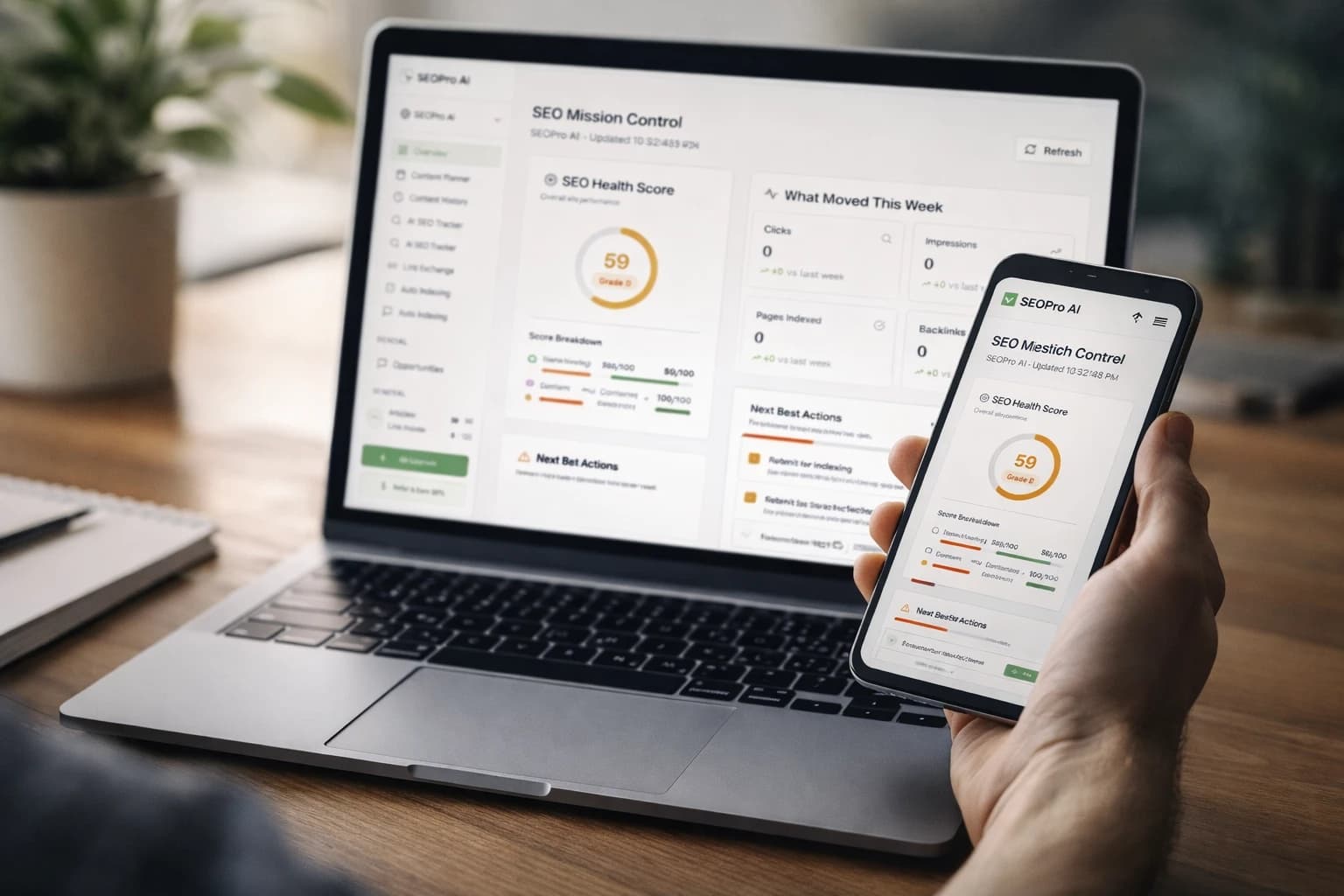
- Adopt SEOPro AI as a SaaS subscription (14-day free trial available) to connect once to your content management system, automate content updates and publishing, embed hidden prompts that increase the likelihood of large language model mentions, and apply schema markup automation and SERP-feature targeting to improve eligibility for rich results and Google Overviews.
| Data Source | What To Capture | How To Export | Frequency |
|---|---|---|---|
| Google Search Console | Queries, positions, impressions, click-through rate, top pages by query | Export interface or application programming interface (API), page and query filters | Weekly baseline, monthly trend |
| Analytics Platform | Organic sessions, engaged time, conversions by landing page | Explorations or scheduled comma-separated values (CSV) | Weekly |
| Rank Tracker | Exact positions by device, grid location, and search feature presence | Scheduled exports with tags per topic cluster | Daily for head terms, twice weekly for long-tail |
| SEOPro AI | Schema health, internal link coverage, large language model and AI mention monitoring, Google Overviews presence | Unified dashboard, automated alerts | Daily checks, instant alerts |
| Backlink Index | Referring domains to tracked pages and competitors | Weekly pull, campaign tags | Weekly |
| Server Logs | Crawl frequency and status by bot | Log parser or data pipeline | Monthly |
Mini example: A software-as-a-service brand prepared a cluster around “customer onboarding.” Before producing a single article, the team defined the commercial pages tied to sign-ups, selected ten informational queries that laddered into those pages, implemented Organization and Article structured data, and configured rank checks in the United States on mobile. That small investment meant the first wave of content launched with internal links and schema in place. As a result, top-five rankings translated to higher click-through rates and trials, rather than vanity visibility.
Execution Checklist to Track Google Keyword Ranking

Watch This Helpful Video
To help you better understand track google keyword ranking, we've included this informative video from Learn With Shopify. It provides valuable insights and visual demonstrations that complement the written content.
With your foundation in place, establish a disciplined routine that captures the right signals and converts them into action. Rankings are volatile in the short term, especially as more results include video, image, and interactive panels. So control for that noise and focus on patterns that matter. Track the position of target pages, the search features that appear, and the competitive context for each query. Then implement changes systematically: refresh content that slipped, expand related subtopics, reinforce internal links, and apply structured data where features are within reach. Finally, pair every change with a timestamp so you can attribute lifts to specific efforts rather than luck.
- Tag each tracked page with a primary query and a compact set of clustered variants, including intent and content type labels.
- Run daily checks for head terms and twice-weekly checks for long-tail and emerging topics; annotate any major algorithm updates or site releases.
- Record whether your result appears with enhancements: featured snippet, people also ask, video pack, sitelinks, and Google Overviews exposure.
- Benchmark two to three direct competitors on the same queries to contextualize gains or losses.
- Refresh content strategically: update statistics, add examples, expand sections that underperform, and prune outdated lines that reduce clarity.
- Strengthen internal links: from high-authority articles to priority pages with descriptive anchors that reflect how users search.
- Expand topical clusters: publish supporting pieces that answer follow-up questions and link back to the hub page.
- Implement or refine structured data on refreshed pages to improve eligibility for rich results and Google Overviews.
- Use SEOPro AI’s AI Blog Writer to draft net-new pieces, then apply semantic optimization checklists and hidden prompts that increase the likelihood of large language model mentions in assistants and AI search engines.
- Automate workflows: set content automation pipelines to update internal links and schema whenever you add or reposition articles.
- Coordinate promotion: prime early clicks and links to help new or updated pages leave the sandbox faster.
| Query Type | Primary Goal | Cadence | Key Notes |
|---|---|---|---|
| Branded navigational | Defend and improve click-through rate | Weekly | Watch sitelinks and knowledge panels for changes |
| Commercial head terms | Top three placement and feature wins | Daily | Monitor competitor tests and search feature shifts |
| Long-tail informational | Aggregate traffic and topical authority | Twice weekly | Batch updates; focus on internal linking and freshness |
| Fresh news or trends | Speed to visibility | Every six to eight hours | Time-sensitive; schema and timely updates are critical |
Expert insight: Industry analyses suggest that featured snippets and other rich results can shift click-through rate by five to 20 percentage points depending on intent. That is why tracking only the numeric position misses the story. If your page sits at position three without enhancements while a competitor owns the snippet, you are not competing for the same clicks. Capture both position and search features, then prioritize structured data and content format changes that help you qualify for those panels.
Validation Checklist
Raw rankings without quality control lead to false confidence. Validate the integrity of your data, confirm that pages are indexable and canonicalized correctly, and separate meaningful movement from random variance. Then triangulate with engagement and conversion data to see whether improved positions translate into results. Close your loop with cohort comparisons, so you can claim causality for changes, not just correlation. Treat this phase like preflight checks: it keeps your program safe, accurate, and accountable when you present outcomes to leaders and clients.
- Verify location and device settings are consistent across checks; avoid personalized results by testing in a clean environment.
- Confirm indexation, canonical targets, and duplicate content issues for every page tied to a tracked query.
- Validate structured data using testing tools; fix errors and warnings and ensure schema reflects on-page content honestly.
- Correlate position deltas with changes in impressions, click-through rate, and conversions by landing page.
- Spot cannibalization: more than one page competing for a query; merge or retarget content to clarify intent.
- Assess competitor changes: new content, title rewrites, link spikes, or structured data additions that explain shifts.
- Attribute outcomes: annotate releases, content refreshes, and outreach so wins have clear owners and replicable steps.
- Measure durability: did gains persist for four weeks or more, including weekend and holiday cycles?
- Check for Google Overviews and generative answers that reduce classic clicks; prioritize enhancements that improve visibility in those contexts.
- Use SEOPro AI monitoring to detect ranking drift and large language model mention loss, then trigger automated playbooks to correct course.
| Signal | Threshold To Act | Likely Cause | Recommended Action |
|---|---|---|---|
| Rank drop of three or more positions for a head term | Two consecutive checks | Competitor update or intent shift | Refresh content depth, adjust headers, add recent stats, reinforce internal links |
| Click-through rate drop with stable positions | Five points or more | Snippets or titles losing appeal; new features stealing attention | Rewrite titles and descriptions, add structured data to qualify for enhancements |
| Impressions up, clicks flat | Two-week trend | More visibility without relevance | Improve intent match, strengthen calls to action, clarify meta descriptions |
| Two pages ranking for the same query | Both in top twenty | Content overlap and cannibalization | Consolidate or retarget one page; update internal links to signal the primary |
| Loss of featured snippet or overview presence | Any time it appears | Schema errors or competitor content format update | Fix structured data, add concise answer boxes, and refresh helpful visuals and lists |
Case example: A publisher noticed an eight percent dip in organic clicks while average positions barely changed. Validation revealed that for three cornerstone articles, a rival adopted clearer step lists and structured data, taking the featured snippet. The team responded by adding precise answer boxes, updating schema, and inserting contextual internal links from related guides. Two weeks later, snippet share returned and clicks recovered. The lesson is simple: verify the feature landscape, not just the rank number, then iterate with focused improvements.
Common Misses
Even strong teams fall into predictable traps that distort their view of reality or slow progress. The most common issues are mixing branded and non-branded data, averaging ranks across devices and countries, and ignoring the growing impact of Google Overviews and other modules that shift attention away from classic results. Another recurring problem is measuring without acting: collecting position data but failing to run experiments that change the page, internal links, or schema. Finally, teams often assume wins will last without maintenance, but competitors and algorithms never stop moving. Catch these pitfalls early and you will save months of frustration.
- Do not average away signal. Segment by intent, device, and country, then present results per segment.
- Do not chase rankings that cannot convert. Tie every tracked query to a page with a clear user journey and business impact.
- Do not overlook search features. Monitor featured snippets, people also ask, images, videos, and Google Overviews.
- Do not ignore schema. Missing or broken structured data reduces eligibility for rich results and lowers click-through rate.
- Do not neglect internal links. Isolated articles rarely gain authority; orchestrate hub and spoke structures.
- Do not set and forget. Revisit content quarterly to refresh data, examples, and competitor gaps.
- Do not rely on screenshots. Use reproducible rank checks with consistent settings and annotations.
- Do not track only head terms. Long-tail queries compound and often convert better with lower competition.
- Do not overlook cannibalization. Consolidate overlapping pages and clarify intent with headings and anchors.
- Do not measure without playbooks. Pair each diagnosis with a prescriptive fix you can run repeatedly.
| Miss | Symptom | Fast Fix |
|---|---|---|
| No segmentation | Conflicting trends and unclear impact | Split dashboards by device, intent, and market; set ownership per segment |
| No structured data | Low search feature share | Implement Article, FAQ, HowTo, and Product where relevant; validate with testing tools and monitor |
| Thin internal linking | New content stalls at positions 11 to 20 | Add two to four contextual links from authority pages; update sitemaps if needed |
| Slow iteration | Weeks pass between diagnoses and fixes | Adopt SEOPro AI workflow templates to ship refreshes and schema updates faster |
| Ignoring Overviews | Clicks fall while positions hold | Prioritize concise answers, trustworthy sourcing, and schema that clarifies entities |
Where SEOPro AI fits: Brands, publishers, and marketers struggle to generate scalable organic traffic, win search features, and maintain stability as artificial intelligence systems influence search. SEOPro AI provides a SaaS, AI-first platform (14-day free trial) with prescriptive playbooks that automate content creation, embed hidden prompts to increase the likelihood of large language model mentions, connect once to content management systems to publish broadly via one-click connectors (WordPress, Shopify, Webflow, HubSpot, Contentful, and headless APIs), implement topic clustering and internal linking strategies, optimize semantic content and schema, and continuously monitor performance to detect and correct ranking or large language model-driven traffic drift. In short, it operationalizes this checklist so your program runs on rails rather than ad hoc effort.
Your Next Move
Build a resilient engine that turns rankings into revenue by aligning measurement, content, technical excellence, and structured data. When you adopt consistent routines and clear playbooks, growth compounds.
Imagine the next 12 months with steady gains from topic clusters, richer visibility through schema, and measurable wins in assistants and Google Overviews. What would it change for your roadmap if every week you could reliably track Google keyword ranking and act on the insights with confidence?
Boost Rank Tracking Success with SEOPro AI
Improve eligibility for search engine results page features and Google Overviews with schema markup guidance, while automating content and monitoring for drift to scale results across your team.
Start Free Trial